

Key Takeaway
Before we get too deep, let’s step back for a second and talk about what this guide is really about. Living with Ménière’s Disease is tough, no doubt. But understanding how your mind, body, and diet interact can give you a real sense of balance, maybe even control. This article explores how stress management, nutrition, and lifestyle choices can work together to support steadier days and long-term well-being.
It discusses how:
- Stress and your inner ear are connected. Emotional strain isn’t just in your head. It can affect fluid pressure and nerve function, often setting off vertigo or tinnitus at the worst times.
- Balanced nutrition builds resilience. A low-sodium, nutrient-rich diet tailored for Ménière’s Disease supports not just ear health but emotional steadiness too. It’s about more than avoiding salt, it’s giving your body what it actually needs to cope.
- Mindfulness is medicinal. Simple relaxation techniques, deep breathing, meditation, even slow stretches, can calm anxiety and help stabilize Meniere’s Disease symptoms. It may feel small, but it really adds up.
- Sleep and pacing protect your equilibrium. Regular rest and predictable routines lower stress responses, helping prevent Ménière’s Disease flare-ups. Skipping these is tempting, sure, but your body pays for it.
- Community and expert guidance matter. Working with a Ménière’s-focused dietitian, or simply connecting with people who get it, can provide reassurance, practical tips, and sometimes relief you can’t get alone.
- Small changes add up. Mindful eating, calm routines, and emotional awareness may feel gradual, but over time, they transform how you manage your Ménière’s Disease symptoms.
Put together, these principles create a foundation for holistic Ménière’s Disease support. They offer a way to steady your days, quiet your mind, and reclaim a little confidence in your body’s ability to find balance, even on the tricky days.
Intro
Living with Ménière’s Disease can sometimes feel like being caught in a storm you can’t quite read. One minute, everything’s calm. The next, your world starts spinning, literally. Vertigo, ringing in the ears, that strange sense of fullness, and the unpredictable dips in hearing… they don’t usually send a warning first.
And it’s not just the physical part (though that’s plenty to handle). There’s the stress of wondering when the next Meniere’s attack might hit, the anxiety of not being able to plan your day with confidence, and that quiet frustration that comes with feeling like your body’s on its own schedule. Over time, that uncertainty wears on you.
But there’s good news tucked in all this chaos. More and more research suggests that when you pair good stress management with a well-balanced Ménière’s-friendly diet and mindful lifestyle habits, things can genuinely start to shift, not overnight, but noticeably.
This guide takes a closer look at how stress and Ménière’s Disease connect, why nutrition plays such a big role, and how simple habits, things like mindfulness, sleep hygiene, or working with a knowledgeable Ménière’s dietitian, can help you feel more grounded. Maybe not “symptom-free,” but definitely more in control.
The Stress–Ménière’s Connection: Understanding the Mind-Ear Relationship
Ask anyone who’s lived with Ménière’s Disease for a while, and they’ll probably tell you the same thing: stress makes it worse. It’s not a coincidence. Surveys and studies keep showing that emotional strain, fatigue, and anxiety often show up right before an attack.
On a biological level, stress sets off a bit of a domino effect, higher cortisol, constricted blood vessels, fluid shifts inside the inner ear. All of that can throw off your balance system and hearing stability. So when doctors say managing stress is “part of the Meniere’s treatment,” they really mean it.
Vertigo and tinnitus, of course, are stressful in their own right. The fear of another dizzy spell can keep you tense, sleep-deprived, even on edge in social settings. That tension, in turn, feeds the body’s stress response, which then stirs up more ear instability. It becomes this frustrating loop:
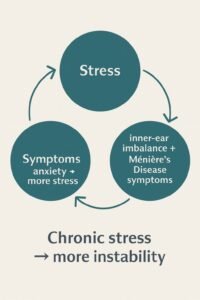
Breaking that loop isn’t about one magic fix. It’s usually a combination of things, psychological tools, physical routines, and yes, nutrition. Mindfulness, gentle movement, Cognitive Behavioral Therapy (CBT), meditation, and better sleep all help that overactive stress system. They don’t “cure” Ménière’s Disease, but they can reduce the number and intensity of attacks. And that alone can change how you live with Ménière’s Disease.
Practical Stress-Management Strategies for Ménière’s Disease
The following toolkit merges psychological, behavioral, and nutritional methods, each compatible with a Ménière’s Disease diet and guided by insights from an experienced Meniere’s Dietitian.
Mindfulness, Breathwork, and Meditation
Mindfulness-Based Stress Reduction (MBSR) programs teach individuals to focus awareness on the present moment without judgment. Regular practice has been shown to reduce anxiety and heighten quality of life in chronic conditions, including vestibular disorders. Employ the following techniques:
- Breathing techniques: Diaphragmatic or box breathing (4-4-4-4) activates the parasympathetic system, calming the body.
- Micro-breaks: During tension or dizziness, pause, close your eyes, and breathe deeply five times.
Consistency, even a few minutes a day, enhances relaxation and resilience, making mindfulness a valuable component of holistic Ménière’s Disease support.
Cognitive-Behavioral and Acceptance-Commitment Therapies
CBT helps identify unhelpful thought patterns such as “I can’t control my attacks.” By reframing fear-based thinking, patients gain confidence and reduce stress intensity. ACT adds mindfulness and acceptance, acknowledging uncertainty while choosing constructive action.
For some, therapy guided by a Meniere’s Dietitian or mental-health professional familiar with vestibular disorders delivers the most comprehensive Ménière’s Disease support approach: addressing both psychological triggers and dietary stability.
Sleep, Rest, and Pacing
A structured sleep routine enhances stress tolerance and overall ear health nutrition outcomes. The routine is as follows:
- Go to bed and wake at consistent times.
- Reduce screen exposure one hour before sleep.
- Avoid caffeine late in the day and keep your room dark and quiet.
- Balance active and rest periods, overexertion can reduce your stress threshold.
Adequate rest also strengthens adherence to the Ménière’s Disease diet, since fatigue can sometimes drive cravings for salty or processed foods.
Gentle Movement and Vestibular Rehabilitation
Physical activity eases muscle tension, boosts circulation, and supports balance. Walking, yoga, tai chi, and swimming promote both relaxation and physical conditioning. Vestibular rehabilitation therapy (VRT) specifically trains the brain to adapt to inner-ear imbalances. Combined with Meniere’s disease nutrition, these activities improve both mental and physical stamina.
Mindful movement like yoga or qigong aligns breathing and posture, grounding the nervous system, one of the most reliable forms of holistic Ménière’s Disease support.
Social Support, Journaling, and Community

Connection alleviates isolation and fear. Try doing the following:
- Talk it out: Share experiences with trusted friends or in peer groups.
- Journal: Track symptoms, stressors, diet, and sleep to discover triggers.
- Join support networks: Online or local communities dedicated to Ménière’s Disease offer guidance and empathy.
These social anchors, paired with professional feedback from a Meniere’s Dietitian, enhance adherence to both stress-management plans and the Meniere’s Disease diet.
Integrating the Meniere’s Disease Diet into Stress Management
Nutrition is the backbone of sustained improvement. When guided by a Meniere’s Dietitian, your Ménière’s Disease diet can evolve into a long-term wellness plan rather than a restrictive routine.
Some of the core principles of the Meniere’s Disease diet is optimized sodium balance, good hydration and overall healthy eating, but it does vary from person to person.
Through consistent implementation, the Meniere’s Disease diet does more than manage fluid pressure; it enhances stress resilience and emotional steadiness, key aspects of holistic Ménière’s Disease support.
How Diet Reinforces Stress Control
The relationship between diet and stress management in Ménière’s Disease is both scientific and deeply practical. What we eat shapes how the nervous system, inner ear, and emotional centers respond to daily challenges. For individuals with Ménière’s disease, where stress and imbalance often intensify vertigo or tinnitus episodes, adopting a mindful nutrition plan can significantly influence recovery and overall well-being.
A well-designed Ménière’s Disease diet supports the body’s ability to regulate hormones, stabilize blood sugar, and maintain optimal fluid balance within the inner ear. Each meal choice, whether it’s reducing sodium or choosing antioxidant-rich foods, can directly impact how resilient the body feels under stress. By aligning nutrition with relaxation and lifestyle habits, patients can create an environment where both the mind and the vestibular system thrive.
Below are key ways in which dietary balance reinforces stress control and enhances stability for people living with Ménière’s Disease:
- Stable glucose = stable mood. Balanced meals prevent irritability and fatigue.
- Reduced inflammation. Antioxidant-rich produce lessens oxidative stress.
- Improved vascular health. Nutrients like omega-3s, magnesium, and potassium optimize circulation to the inner ear.
Together, these mechanisms define the integrated science of Ménière’s disease nutrition, uniting body chemistry and emotional balance.
Each positive choice reinforces your Meniere’s Disease Diet and protects long-term ear health nutrition.
For a full breakdown of what a Meniere’s Disease Diet includes, see this complete guide.
How a Meniere’s Dietitian Enhances Recovery
The role of a Ménière’s Dietitian goes far beyond meal plans and sodium counts. It’s usually about building a healthier, more trusting relationship between food, body, and mind. Living with Ménière’s Disease can feel like walking on shifting ground, literally and emotionally. One day might start out fine, and by afternoon, you’re dizzy, nauseous, or hearing that relentless ringing again. It’s unpredictable. And that unpredictability can quietly chip away at your confidence.

A skilled Ménière’s Dietitian understands that. They don’t just talk about nutrients and hydration; they help you steady the emotional waves that come with the physical ones. Working with someone trained in Ménière’s Disease, and often, in stress management too, means you’re not facing it alone. Their approach is holistic, aiming to ease both the biological and psychological triggers that can spark flare-ups.
They might start with practical changes, like learning how to track sodium or spot hidden salt in packaged foods. But that’s only part of it. They also help you rebuild trust with food, so eating doesn’t feel like a guessing game. Simple habits like mindful eating, or taking time to plan meals instead of reacting to cravings, can go a surprisingly long way in lowering anxiety.
Many people discover, with guidance, that it’s not only salt that sets them off. Things like MSG, caffeine, alcohol, or even certain artificial sweeteners can worsen dizziness or tinnitus. It’s frustrating, because some of those things feel harmless. But a dietitian can help you identify those patterns and swap triggers for stabilizers: potassium-rich foods that balance fluids, magnesium-based snacks that calm the nervous system, antioxidant-rich meals that quietly support your resilience.
Over time, the Meniere’s diet becomes less of a strict “Ménière’s plan” and more of a lifestyle that feels supportive rather than restrictive. In the end, the connection between a patient and a Meniere’s Dietitian can be quietly transformative. It’s not a quick fix, but a partnership built on empathy and small, steady progress. And maybe that’s the real goal, not just fewer dizzy spells, but a genuine sense of balance again, inside and out.
This is exactly the kind of personalized support a Meniere’s Disease Dietitian provides.
Holistic Meniere’s Support and Mind-Body Connection
Living with Ménière’s Disease teaches you something most people never stop to think about, that the mind and body aren’t separate. They’re more like two sides of the same coin, constantly influencing each other. When stress, anxiety, or even small bits of muscle tension creep in, the symptoms can flare. Vertigo, ear pressure, tinnitus, they all seem to turn up the volume when life gets heavy. It’s a loop that feeds on itself: the more you worry, the more your body reacts, and the harder it becomes to calm down.
That’s why paying attention to the mind-body connection is essential. Not in a vague, self-help way, but in a real, physiological sense. I think anyone who’s lived through a dizzy spell during a stressful week knows what I mean.
Gentle movement can help break that cycle. Things like yoga, tai chi, light stretching, or even a slow swim. They get your blood flowing, loosen the tension you didn’t even realize you were carrying, and help your balance retrain itself over time. There’s something almost meditative about it, the body softens, the breath evens out, and the nervous system starts to believe it’s safe again. And when you pair that with a steady nutrition plan tailored for Ménière’s Disease, it all works together. You start to feel a bit more at home in your body again.
But holistic care isn’t only about the body. The emotional part matters just as much, maybe even more on some days. The unpredictability of Ménière’s Disease can chip away at your social life and your sense of normalcy. It’s not uncommon to withdraw, to stay home because you’re scared of an attack, or simply too drained to explain how you’re feeling. That’s where creativity can help. Painting, journaling, gardening, music, anything that lets emotion move instead of sitting stagnant inside you. Those small outlets can shift your chemistry in subtle ways. It’s not magic, but it helps.
And then there’s community. That quiet comfort of hearing someone say, “Yes, I’ve been through that too.” Support groups, online or in person, can make a world of difference. They remind you that you’re not fighting in isolation, that other people understand the fear and frustration. There’s real relief in that kind of understanding. It lightens the emotional load and, in turn, the physical one.
Conclusion
Living with Ménière’s Disease isn’t something you simply manage, it’s something you learn to live alongside, day by day. It calls for courage, flexibility, and a deep understanding of your own body’s signals. Yet, through a Ménière’s Disease diet, many rediscover a sense of control they thought they’d lost. Food becomes and enjoyable part of life again. Mindfulness turns into quiet therapy. And community, those who truly understand, becomes a powerful source of support.
Guidance from a skilled Ménière’s Dietitian, connection with support networks, and a steady commitment to holistic care all add up to something profound: a life that feels balanced again. Each small choice, each mindful meal, strengthens not only inner ear stability but emotional resilience, too.
Managing Ménière’s Disease is a partnership with yourself. By caring for both body and mind through low-sodium meals, steady hydration, stress awareness, and ear health nutrition, you begin to rebuild a sense of peace that lasts. Not every day will be easy, but over time, clarity returns, in hearing, in balance, and in spirit.
Ready to build a plan that supports both your stress levels and your symptoms? Explore Pricing & Packages or contact me today.